

Linksys, D-Link routers hacked to spread coronavirus malware: What to do now (UPDATED)
Linksys, D-Link routers hacked to spread coronavirus malware: What to exercise now (UPDATED)
UPDATED April 15 to annotation that Linksys has reset all passwords to its users' Smart Wi-Fi remote-access accounts. More below. This story was originally published March 27.
If you've got a Linksys or D-Link habitation Wi-Fi router, cheque right at present to make sure its authoritative password is strong and unique -- and that the router isn't still using the default admin password it shipped from the factory with.
That's considering criminal hackers are "brute-forcing" router admin passwords over the net so that they tin can change the router DNS settings to attack your devices with coronavirus-themed malware, according to researchers at Bitdefender and users of the Bleeping Figurer forum.
- The best Wi-Fi routers: Keep your habitation network's point stiff
- The ane router setting everyone should change (but no 1 does)
- New: Alexa tin can at present screen you for coronavirus: How to use it
Your net traffic will then be re-routed to scam coronavirus-related websites that will attempt to infect your Windows computer with information-stealing malware that volition try to steal your passwords, credit-carte du jour numbers, session cookies and cryptocurrency.
- Setting upward a virtual router is the perfect way to share your connections
How to protect yourself from this set on
To protect yourself, the first thing y'all need to practice is to modify your router's admin password to something unique and strong and and so restart the router.
Bank check your router's DNS settings for manual entries "109.234.35.230" and "94.103.82.249". If those numbers (in fact, IP addresses) are nowadays, articulate them, restart the router and the restart any device at dwelling that connects to the internet through the router.
Don't allow your browser save credit-bill of fare numbers, or any of import passwords -- it's as well easy to hack. Use one of the best countersign managers instead.
If you lot have one of the best antivirus programs installed, it will likely detect the Windows malware downloaded from this campaign. Merely antivirus software tin can't fix your router settings -- only yous can do that.
- A router VPN is the best mode to secure your Wi-Fi at abode
How the attack works
DNS is sort of the net'southward phone book -- it matches the website address (URL) you lot type into your computer, such equally "world wide web.foobar.com", to the REAL network Internet Protocol (IP) accost, which is a series of numbers that might expect something similar "188.225.172.30". (I made that i up and it doesn't go anywhere.)
But if hackers corrupt your router, they tin can alter the DNS settings so that "foobar.com" points to an entirely different IP accost. When that happens, you might recollect you're going to the existent "foobar.com" -- and the address bar in your browser will say so -- but y'all'll really exist on an entirely unlike website.
That's what's happening here. The hackers are redirecting traffic intended for Amazon, Disney, Cox, Reddit, the University of Washington, the Academy of Florida and half a dozen other websites, Bitdefender reports, to a website that immediately pops up a message window.
Bleeping Estimator thinks the situation is even worse -- it has evidence that the corrupted DNS settings hijack a built-in Windows function that periodically checks internet connectivity, with the result that almost whatsoever website will pop up the hackers' message.
The message pretends to be from the Earth Health Organization and urging you lot to download and install an awarding that volition give y'all "the latest data and instructions about coronavirus (COVID-nineteen)".
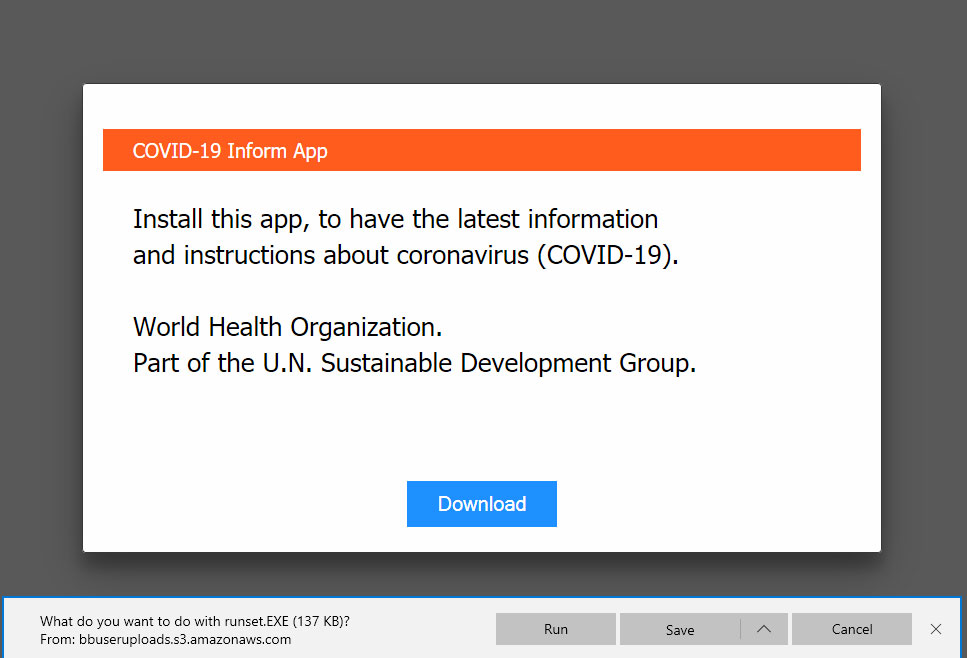
Don't exercise it. The application is actually the Oski information-stealing Trojan, a fairly new piece of data-stealing malware.
D-Link and Linksys routers seem to be targeted because many of those brands' home Wi-Fi routers ship with a remote-access function enabled by default. Turn that function off -- if it's left enabled, then the simply thing protecting a router from remote attack is the strength of its admin password.
UPDATE: Linksys resets remote-account passwords
Linksys told The Register Apr fifteen that it locked all Linksys Smart Wi-Fi accounts on April 2, then later forced a password reset on those accounts.
Linksys Smart Wi-Fi lets you "access your home network from anywhere, at any time, even from your mobile device."
Honestly, that's a actually bad thought, and Linksys should accept anticipated that thousands of its users would only utilise the same usernames and passwords for Smart Wi-Fi that they used for other accounts.
The unsurprising result: A wave of credential-stuffing attacks on Linksys routers based on credentials stolen in other companies' information breaches.
"The majority of hallmark requests [in these attacks] contained usernames that have never registered on our organization," Linksys spokeswoman Jen Wei Warren told The Register. ""Multiple attempts were made using the same username but different passwords, which would not be necessary if our own systems were compromised."
As we stated before, if you have remote access enabled on your D-Link or Linksys dwelling house Wi-Fi router, plow the access off. The risks information technology creates far outweigh the convenience.

Source: https://www.tomsguide.com/news/coronavirus-router-hack
Posted by: roebuckthessiscoved.blogspot.com
0 Response to "Linksys, D-Link routers hacked to spread coronavirus malware: What to do now (UPDATED)"
Post a Comment